



If you're packaging essential oils, tinctures, serums, or other liquid formulations, you've likely come across two similar-sounding but very different closure options: the vertical dropper cap and the glass dropper assembly. While both deliver products one drop at a time, they are not interchangeable, and choosing the wrong one can mean leaks, poor seals, or a product that simply doesn't dispense the way you expect. Here's what sets them apart.
What Is a Vertical Dropper Cap?
A vertical dropper cap forms a specialized closure for your purpose-built dropper bottle. Once you apply the cap, the dropper tube stays inside the bottle permanently. To dispense product, you hold the dropper bottle upright and let controlled drops release from the tip. Output speed varies with product viscosity, since thinner liquids drop faster than thicker ones do.
The most common size is 18 mm, often referred to in the industry as 18 GL. "GL" is the French designation for the German DIN standard (Deutsches Institut für Normung) neck finish, which is why you'll see both terms used interchangeably.
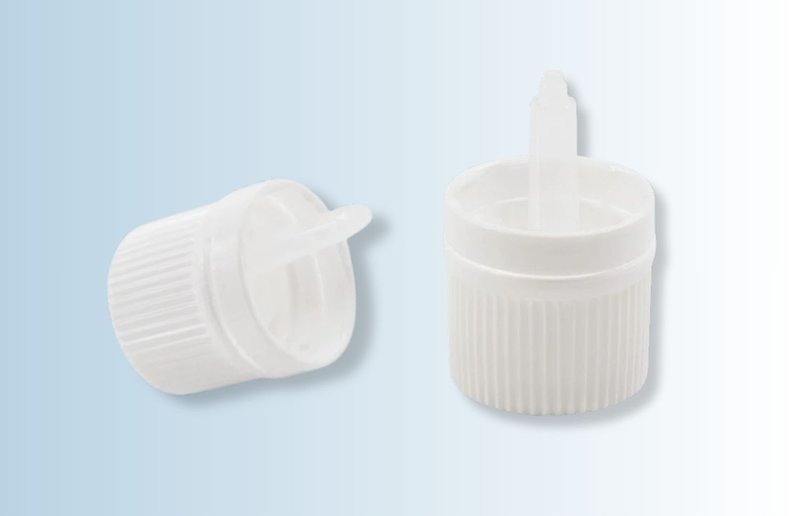
Vertical dropper caps most commonly include a tamper-evident (TE) band, a valuable feature for consumer trust and regulatory compliance. This works because the bottle itself has a matching tamper-evident bead molded into the neck, designed specifically to engage with the TE cap. This is also why vertical dropper caps are so popular for essential oils - they combine precise dosing with visible tamper protection in a single closure.
Because the cap-to-bead fit is so specific, a vertical dropper cap will not work on standard bottle necks. It requires a vertical dropper bottle by design.
What Is a Glass Dropper Assembly?
A glass dropper assembly is a different system altogether, built from three components: a bulb, a cap, and a glass pipette. Unlike the vertical dropper cap, this assembly is typically used with standard bottle types. This includes 400 finishes, Boston Rounds, Metric Rounds, and Winchesters, rather than a dedicated dropper bottle.
Richards Packaging stocks a range of pipette lengths, most commonly with a straight point tip, though other styles exist in the broader market, including bent ball and blunt pipettes. Stocked assemblies typically feature 100% rubber bulbs, chosen for their broad chemical compatibility. Synthetic bulbs can look similar but often run into compatibility issues depending on the formulation being packaged, so rubber remains the more versatile default.

For added functionality, glass dropper assemblies can be special-ordered with printed graduations on the pipette for precise measurement, and child-resistant (CR) caps are also available as a special-order option.
One important distinction: a vertical dropper cap will not fit a bottle designed for a glass dropper assembly, and vice versa. The two systems are built around different neck geometries and sealing mechanisms.
Tamper Evidence Without a TE Bead
Since standard round bottles used with glass dropper assemblies don't have a tamper-evident bead, shrink bands are commonly added as a separate tamper-evident solution when that level of protection is needed.
A Key Fit Tip
When combining a dropper assembly with a vertical dropper bottle, make sure the cap doesn't bottom out on the bead during application. If it does, the cap may not compress the seal properly, risking leaks or poor closure integrity. This is a small detail, but it makes a real difference in final product performance.
Frequently Asked Questions
- What size is a standard vertical dropper cap?
- The most common size is 18 mm, also called 18 GL, based on the German DIN neck finish standard.
- Can a glass dropper assembly fit a vertical dropper bottle?
- Only as a special order - standard glass dropper assemblies are designed for round bottles like Boston Rounds, not vertical dropper bottles.
- Why are rubber bulbs preferred over synthetic ones?
- Rubber bulbs offer broader chemical compatibility, while synthetic bulbs can react poorly with certain formulations.
- How do you add tamper evidence to a glass dropper assembly bottle?
- Since there's no TE bead on standard round bottles, a shrink band is the typical solution.


